For brand owners and B2B importers in the DIY craft niche, choosing the right product dimensions isn’t just a creative choice—it’s a financial one. In the world of “5D” art, size directly dictates image quality, shipping overhead, and retail price points.
This guide breaks down everything a procurement manager needs to know about diamond painting sizes to ensure your next shipment hits the “sweet spot” of customer satisfaction and healthy margins.
1. Understanding Standard Diamond Painting Sizes
When sourcing from China, you will typically see a range of standard dimensions measured in centimeters. For B2B buyers, these are generally categorized into three tiers:
- Small (Starter) Sizes: $20 \times 20$ cm or $30 \times 30$ cm. These are perfect for low-cost “stocking stuffer” items or beginner kits.
- Medium (Standard) Sizes: $30 \times 40$ cm or $40 \times 50$ cm. This is the most popular range for Amazon sellers and e-commerce brands because it balances detail with affordable shipping.
- Large (Premium) Sizes: $50 \times 70$ cm, $60 \times 80$ cm, and above. These are targeted at “expert” crafters who want photo-realistic results.
2. The Relationship Between Size and Image Detail
The most common mistake new brand owners make is trying to fit a complex, detailed image onto a small canvas.
Think of diamond painting sizes like pixels on a screen. Each “drill” (the resin diamond) is roughly $2.5$ mm or $2.8$ mm wide.
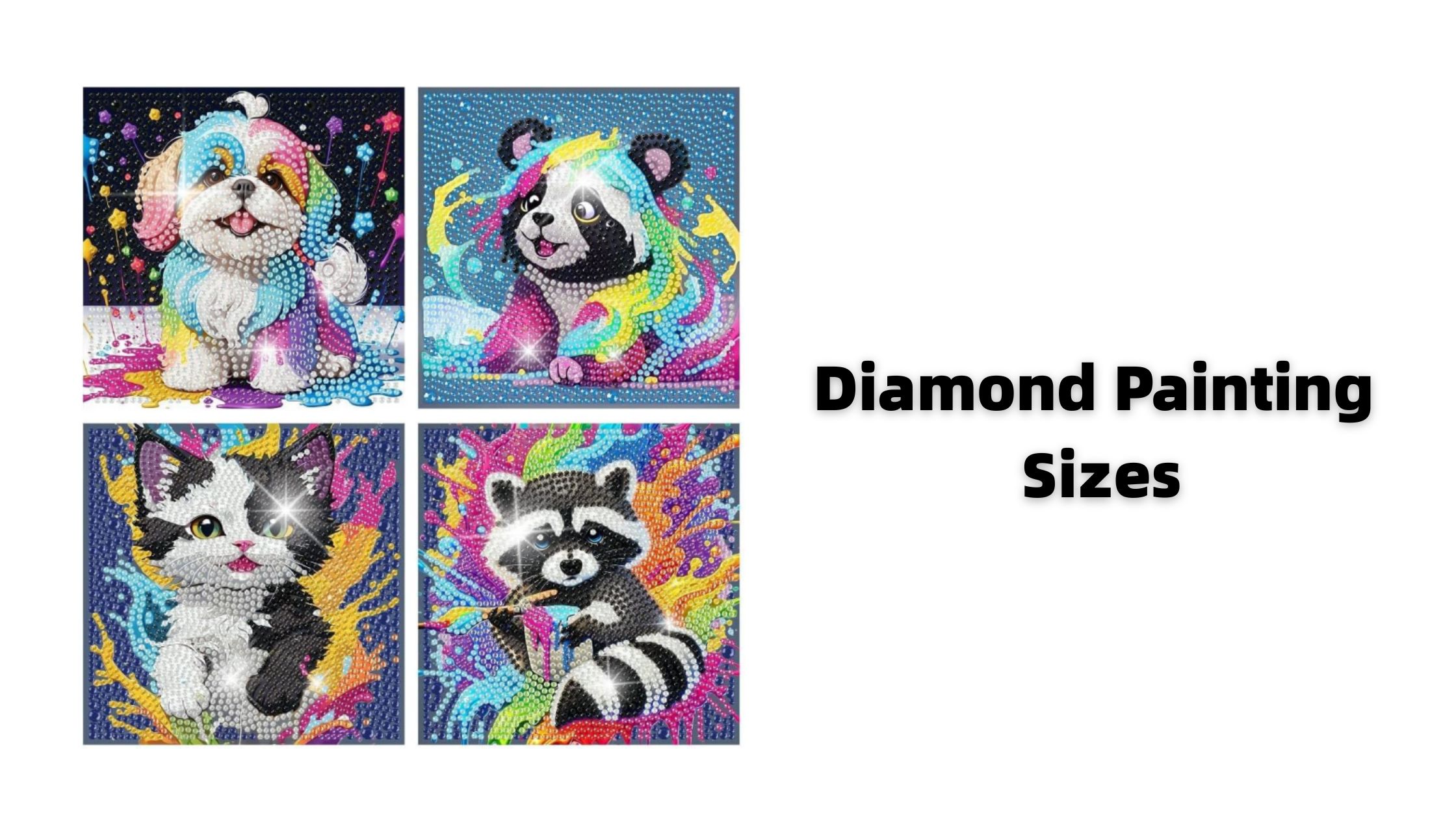
- Small Canvas ($20 \times 30$ cm): Results in a “pixelated” or blurry look. Best for simple icons, cartoons, or kids’ designs.
- Large Canvas ($60 \times 60$ cm+): Allows for sharp transitions, facial features, and intricate landscapes.
B2B Tip: If your brand focuses on custom “Personalized Photo” kits, never recommend a size smaller than $40 \times 50$ cm, or you will face high return rates due to poor image clarity.
3. Shipping and Logistics: The CBM Factor
As a sourcing professional, you know that “Volume is Money.” The physical dimensions of the canvas determine the length of the shipping tube or box.
- Roll Length: A $40 \times 50$ cm canvas is usually rolled along the shorter side ($40$ cm). This affects how many units you can fit into a standard shipping carton.
- Weight vs. Volume: Large diamond painting sizes require more resin drills. A $60 \times 80$ cm kit can weigh three times more than a $30 \times 40$ cm kit, significantly increasing your air freight costs.
4. Market Positioning: Which Sizes Should You Stock?
To build a balanced inventory, we recommend a “Pyramid Strategy”:
- 60% Volume (The Core): Stick to $30 \times 40$ cm. These are the “bread and butter” of the industry.
- 30% Entry Level: $20 \times 30$ cm kits for kids or promotional giveaways.
- 10% Premium: Large, complex designs to showcase your brand’s quality and attract serious hobbyists.
FAQ: Sourcing Diamond Painting Sizes
What is the most popular diamond painting size for Amazon sellers?
The $30 \times 40$ cm (approx. $12 \times 16$ inches) is the industry standard. It is large enough to show decent detail but small enough to keep the retail price under $15–$20.
How do I know if my design is too complex for a specific size?
Ask your supplier for a “Rendering” or “Software Mockup” before production. If the eyes or small text in the rendering look like blocks of color, you need to increase the canvas size.
Are custom diamond painting sizes available for B2B orders?
Yes. Most factories can cut canvas to any dimension. However, choosing “non-standard” sizes might increase your packaging costs as the factory will have to source custom-sized boxes or tubes.
Does the size of the canvas include the border?
This is a critical procurement question! Some suppliers list the “Canvas Size” (including the white border/legend), while others list the “Pasting Area” (the actual area covered by diamonds). Always clarify this in your Purchase Order (PO) to avoid customer complaints about the kits being smaller than advertised.
Why is there a price jump for sizes over 50 cm?
Beyond the extra drills and canvas, larger sizes often require thicker packaging (to prevent creasing) and more labor for quality inspection, which the factory will pass on to the buyer.