
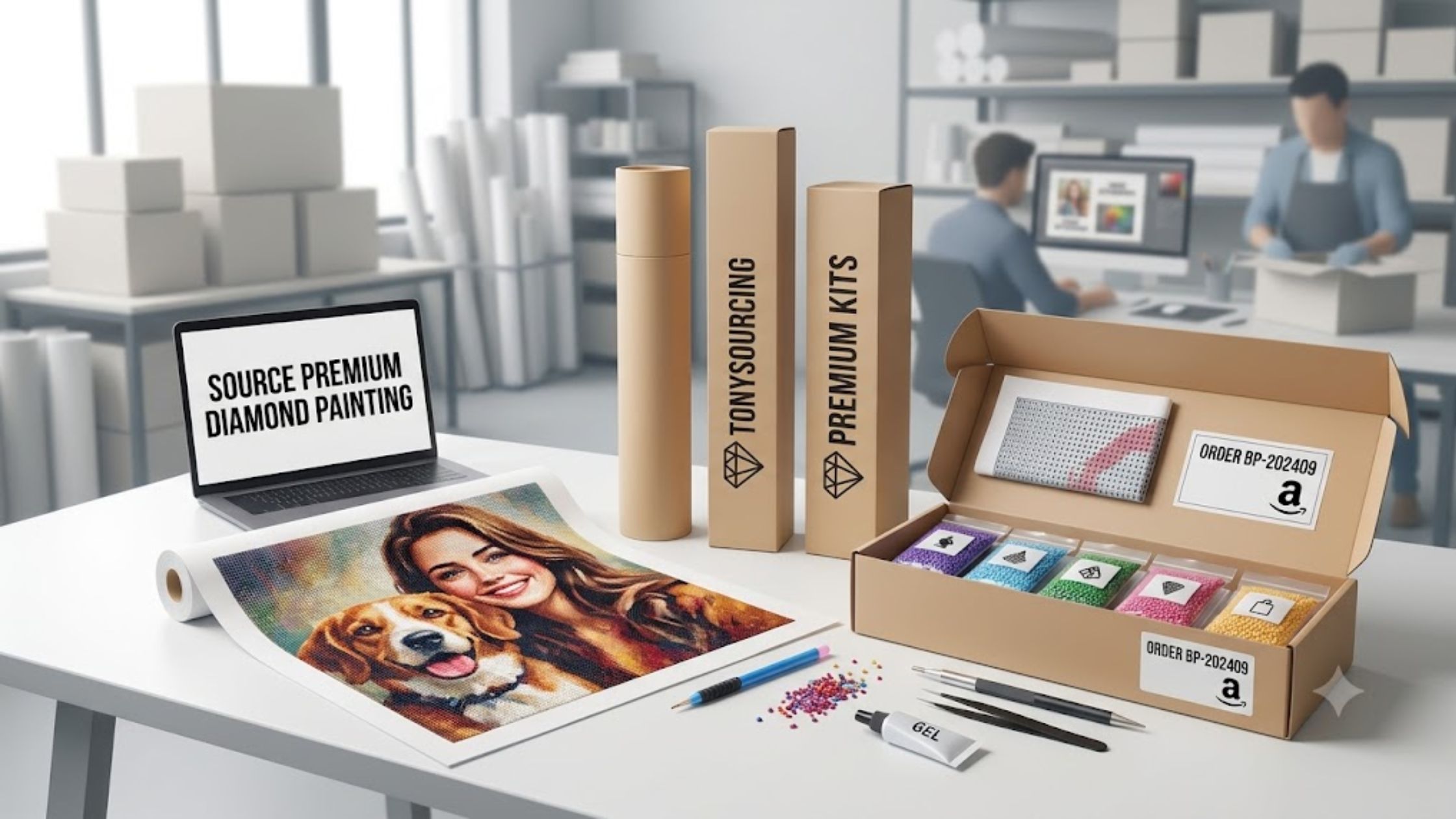
Are you struggling with 1-star reviews due to missing diamonds, creased canvases, or blurry custom photo prints? As a B2B buyer, you know custom diamond painting offers high margins. However, cheap factory execution will destroy your brand’s reputation.
This guide shares our real manufacturing insights. We will help you secure a premium, retail-ready supply chain to keep your buyers coming back.
3 Manufacturing Standards That Separate Premium Kits From Cheap Factory Waste
If you want to justify a premium retail price on Amazon or your Shopify store, you cannot rely on standard wholesale market stock. You must control three critical factory variables.
1. Poured Glue vs. Double-Sided Tape (The Dynamic of Longevity)
Many factories cut costs by using double-sided adhesive tape on the canvas. From our inspection experience, this is a ticking time bomb for your business. Tape dries out in transit, bubbles up when unrolled, and loses its stickiness within months, causing the diamonds to fall off.
Our Sourcing Insight: You must insist on poured glue (hydrogel). It requires a multi-day curing process at the factory, but it creates a permanent bond that remains sticky for years. When your customers open your box, the canvas must lay perfectly flat without wrinkles.
2. Manual Graphic Rendering vs. Automated AI Layouts
When your customer uploads a custom portrait, never let a factory use 100% automated software. Automated cropping completely ruins human facial features. It distorts eyes and blends complex shadows into messy, unreadable symbol blocks.
Our Sourcing Insight: Premium brands stand out because they invest in human graphic designers who manually optimize every single uploaded image before printing. They manually adjust the contrast, clean up background noise, and ensure that skin tones use distinct, legible chart symbols so the end-user isn’t left guessing.
3. 100% ABS Resin Beads vs. Recycled Acrylic Trash
The shine of the final piece determines your customer’s satisfaction. Cheap kits use molded acrylic diamonds. Acrylic beads look dull, have uneven sizes, and contain a high percentage of “plastic flashing” (excess plastic debris) that clogs your customer’s workspace.
You should strictly source 100% premium ABS resin diamonds with 26 precise facets. Resin delivers a true mosaic-like shimmer, consistent sizes, and vibrant colors that do not fade over time.

Channel Strategies: Custom Solutions Based on Your Business Model
Your sourcing strategy must align directly with how you sell. A one-size-fits-all kit will fail your specific operational needs.
If You Are an Amazon FBA or Etsy Seller: Your Goal is Review Protection
Amazon buyers are ruthless regarding missing parts. If a hobbyist spends 30 hours on a custom piece and runs out of one vital color, you get an immediate 1-star review.
- Your Action Plan: Require your supplier to pack 30% extra diamonds for every color code (DMC chart). Furthermore, ditch standard plastic polybags. Switch to rigid, branded cardboard tubes to ensure the canvas arrives completely crease-free.
If You Are a DTC Shopify Brand: Your Goal is Seamless POD Integration
For independent brands running a Print-on-Demand (POD) model, you cannot hold massive inventory. You also cannot afford 2-week production delays.
- Your Action Plan: Partner with a supplier whose backend integrates with your website via API. This allows custom image uploads to transfer directly to the production line. Your partner must guarantee a 3-to-5 day turnaround and provide blind dropshipping with your logo on the label.

Deep-Dive B2B FAQ: Technical Specifications and Supply Chain Logic
Q1: What is the exact mathematical ratio between custom image resolution and canvas size to prevent pixelation?
A: For a standard 30x40cm canvas, the source image must be at least 1200×1600 pixels. However, if your customer uploads a detailed group photo, a small canvas will turn human faces into abstract blobs. For complex images, you must guide your buyers to order 40x50cm or larger, as the spatial density of the diamond beads (2.5mm per square drill) requires a larger surface area to render fine details.
Q2: How do you mathematically calculate and audit the diamond count to guarantee zero customer shortage?
A: We calculate the exact drills needed per square centimeter. Next, we convert that into grams per color code. Finally, we program automated scales to add a strict 30% buffer. We cross-check packet weights before sealing the shipping carton.
Q3: What specific chemical and safety certifications do custom kits need for Western customs clearance?
A: To import into the US and EU without legal risk, your kits must comply with EN71 (Part 3) and REACH regulations. This means the poured hydrogel glue must be free of harmful volatile organic compounds (VOCs), and the ABS resin beads must be certified lead-free and non-toxic, especially if you are targeting the children’s craft demographic.
Q4: How do you handle flexible MOQ requirements for brands testing new custom product lines?
A: We operate a dual-track production system. For established private labels, we run high-volume offset printing presses to lower your unit costs. For startup brands or POD stores testing the waters, we utilize high-resolution digital inkjet textile printers that allow us to manufacture single-unit custom canvases without requiring expensive plate-making setup fees.
Conclusion: Secure Your Supply Chain Advantage
To dominate the custom diamond painting market, you must stop competing on low prices and start competing on supply chain execution. By securing poured glue stability, manual rendering checks, and resin purity, your brand naturally eliminates returns and drives repeat business.
If you are an Amazon seller, private label owner, or wholesale distributor ready to upgrade your product quality and eliminate supply chain headaches, FashionDiamondPainting.com is your boots-on-the-ground partner in China. We handle factory audits, manual artwork checks, and strict quality control. [Contact FDP Today] to get a professional quote and request a physical sample kit!


